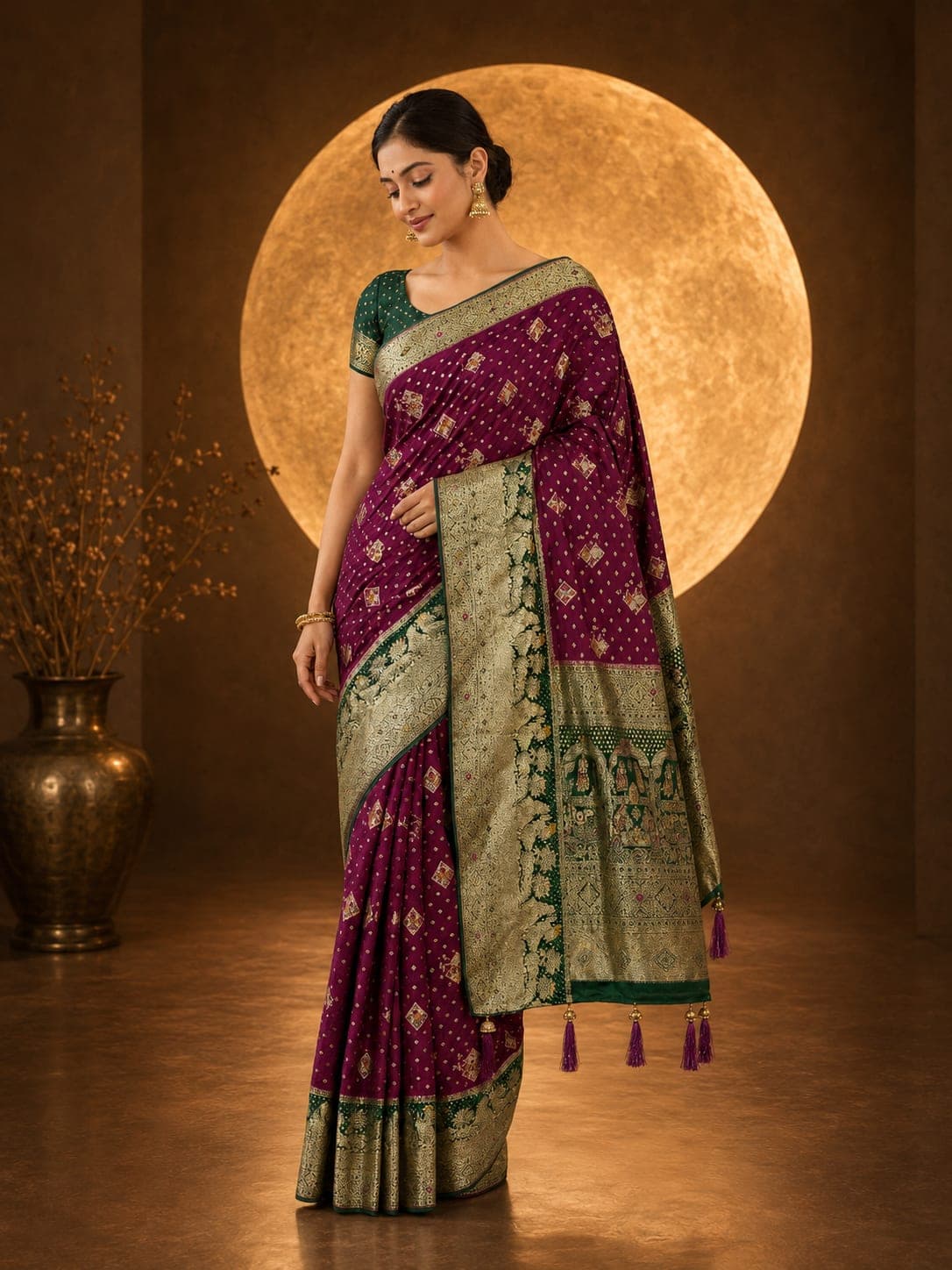
Bandhani (also known as Bandhej) is one of India's oldest and most recognisable textile arts — a form of **tie-dye** that dates back over 5,000 years. The word comes from the Sanskrit "bandha" (to tie), and the technique involves creating patterns by **pinching tiny points of fabric and tying them tightly with thread** before dyeing.
How Bandhani is Made
1. The fabric (usually silk, cotton, or georgette) is first marked with a pattern using a washable dye 2. Skilled artisans **pinch each dot with their fingernails** and tie it with a thin thread — an expert can tie 600–800 dots per hour 3. A single saree may contain **30,000 to 50,000 individual ties** 4. The tied fabric is then dipped in dye baths — starting with the lightest colour and progressing to the darkest 5. When untied, each tiny dot retains its original colour, creating the characteristic Bandhani pattern
Major Bandhani Patterns
- **Ekdali** — single dots scattered across the fabric - **Shikari** — dots arranged in a wave or diagonal pattern - **Jaaldar** — intricate lattice or net pattern of dots - **Chandrakala** — moon-shaped motif patterns - **Beldaar** — vine and creeper patterns along the border
Regional Variations
**Gujarati Bandhani:** Produced mainly in Jamnagar, Bhuj, Mandvi, and Rajkot. Known for vivid reds, greens, and yellows. Often combined with Gaji Silk for bridal Gharchola sarees. The Khatri community are the traditional master dyers.
**Rajasthani Bandhani:** Produced in Jodhpur, Jaipur, Sikar, and Bikaner. Tends toward brighter, more saturated colour combinations. Often features wider spacing between dots and bolder patterns.